

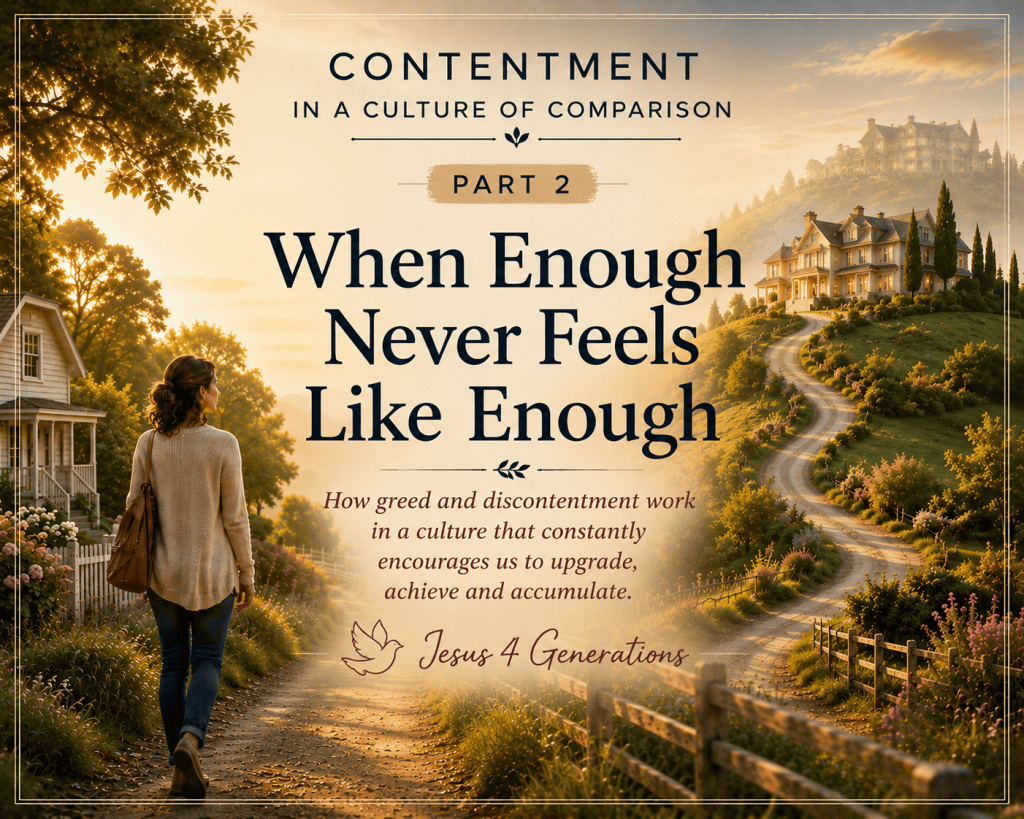
Contentment in a Culture of Comparison — Part 2
Have you ever finally received something you really wanted…
only to discover that, not very long afterwards, you wanted something else?
Perhaps you saved for the new car.
You renovated the kitchen.
You got the promotion.
You moved into the better house.
You upgraded the phone.
You reached the financial goal.
And for a while, it felt wonderful.
But then something happened.
The new became normal.
And another something appeared on the horizon.
[Pause and think about that for a moment.]
There is nothing necessarily wrong with any of those things.
But there is something worth paying attention to when our hearts continually whisper:
I’ll be satisfied when…
Because if enough is always somewhere ahead of us, we will spend our lives chasing it.
This is Part 2 in the Contentment in a Culture of Comparison Series.
If you haven’t already read Part 1, I’d encourage you to go to When Comparison Steals Our Joy: How “Enough” Becomes “Not Enough” as each of these messages build on the previous one.
🎙️ Listen to the Podcast
Prefer to listen? You can enjoy a shorter version of this message on Jesus 4 Generations as a podcast.
Click the link below to listen for free on Podbean, or find Jesus 4 Generations on your favorite podcast platform, including Apple Podcasts, Spotify, and more.
We Live in a Culture Built Around “More”
We live in an extraordinary time.
Many of us have access to comforts that previous generations could barely have imagined.
And yet we are continually being told that what we have isn’t quite enough.
Our phone is perfectly functional — but there’s a newer one.
Our television works — but there’s a bigger one.
Our kitchen is fine — but someone else’s renovation looks spectacular.
Our clothes still fit — but fashions have changed.
Our car gets us where we need to go — but the new model has features ours doesn’t.
And social media has taken comparison to an entirely different level.
Once upon a time, we mostly compared ourselves with people we actually knew.
Now, before we’ve even had breakfast, we can compare our home, appearance, marriage, holidays, children, career, fitness, finances and lifestyle with hundreds of people.
And we’re usually comparing our ordinary Tuesday morning with somebody else’s carefully selected highlight.
No wonder enough can begin to feel inadequate.
There Is Nothing Wrong With Wanting to Grow
This is where we need discernment.
Contentment does not mean having no goals.
It doesn’t mean refusing opportunities.
It doesn’t mean never renovating your house, buying a better car, pursuing a promotion, travelling, saving money or building something worthwhile.
God has given us abilities, creativity and opportunities, and Scripture certainly doesn’t teach us to be lazy or irresponsible.
The issue isn’t simply:
Do I want more?
Perhaps the better questions are:
Why do I want more?
What do I believe having more will give me?
And perhaps most importantly:
Will I still be okay if God says, “Not now” — or even “No”?
That’s often where the heart reveals itself.
Greed Rarely Introduces Itself as Greed
Most of us probably don’t wake up in the morning thinking:
Today I’m going to be greedy.
Greed is usually much more respectable than that.
It can sound like:
I deserve this.
We’ve worked hard.
Everyone else has one.
It’s only a little more.
Once we get this sorted, we’ll be comfortable.
Once I earn this much, I’ll feel secure.
Once we have that house, life will be easier.
None of those statements are automatically wrong.
But they can become dangerous when more begins carrying the weight of our peace, identity or security.
Jesus told a story about a man who had accumulated an abundance.
His land produced so much that he didn’t have enough room to store everything, so he decided to tear down his barns and build bigger ones.
Then he said to himself:
And I’ll say to myself, “You have plenty of grain laid up for many years. Take life easy; eat, drink and be merry.”’
Luke 12:19 (NIV)
But God called him a fool.
Why?
Not because his farm was successful.
Not because planning ahead was wrong.
Not because having barns was sinful.
The problem was where he had placed his security.
He had accumulated earthly wealth but had neglected what mattered eternally.
Jesus concluded:
“This is how it will be with whoever stores up things for themselves but is not rich toward God.”
Luke 12:21 (NIV)
That’s confronting.
Because the issue wasn’t merely what the man possessed.
It was what possessed his heart.
More Promises Something It Cannot Deliver
Greed is insatiable because the thing we’re chasing often isn’t really the thing we’re longing for.
We think we want the bigger house.
But perhaps what we’re really craving is status.
We think we need more money.
Perhaps what we’re really craving is security.
We want the promotion.
Perhaps underneath it is a desire to feel significant.
We want people to notice what we’ve achieved.
Perhaps we’re longing to feel valued.
We want the beautiful home, successful children, perfect holiday photographs or impressive lifestyle.
Perhaps we’re hoping they will tell the world — and ourselves:
I’m doing okay.
And this is why accumulating more cannot permanently satisfy us.
We’re asking something external to meet a need that is internal.
When Desire Becomes Greed
So where is the line?
When does enjoying God’s provision become greed?
I don’t think there’s a simple dollar figure.
A person with very little can be consumed by greed, while someone with considerable wealth can be extraordinarily generous and surrendered to God.
Greed is a heart issue.
It may be worth asking ourselves:
Am I continually dissatisfied with what I have?
Do I find it difficult to celebrate when someone else receives something I want?
Am I taking on financial pressure simply to maintain an image?
Do I believe I’ll finally be happy or secure when I reach the next financial milestone?
Am I accumulating while becoming less generous?
Do I make major decisions prayerfully — or impulsively when I see something I want?
Could I hold what I own with an open hand if God asked me to?
Those aren’t questions for judging somebody else’s lifestyle.
They’re questions for examining our own hearts.
We must remember God is interested in our heart and where our true treasure is.
Scripture Gives Us Another Way
Paul wrote something remarkable from prison:
“I am not saying this because I am in need, for I have learned to be content whatever the circumstances.”
Philippians 4:11 (NIV)
Notice the word learned.
Paul wasn’t necessarily born content.
Contentment was something he learned.
He continued:
“I know what it is to be in need, and I know what it is to have plenty. I have learned the secret of being content in any and every situation, whether well fed or hungry, whether living in plenty or in want.”
Philippians 4:12 (NIV)
Paul had experienced both.
Lack and abundance.
And neither determined his peace.
Then comes one of the most quoted verses in Scripture:
“I can do all this through him who gives me strength.”
Philippians 4:13 (NIV)
We often use that verse when we’re attempting something difficult.
But in context, Paul is talking about learning to live faithfully with little or plenty.
Christ was his sufficiency in both.
That changes how we understand contentment.
Contentment isn’t pretending we don’t have needs.
It isn’t refusing to improve our circumstances.
And it certainly isn’t believing poverty is somehow more spiritual than having money.
Contentment is being able to say:
“Lord, whether I have little or much, my peace does not depend upon what I possess. My security is in You.”
The Goalpost That Keeps Moving
Our culture will always give us another goalpost.
Earn this much.
Own this.
Upgrade that.
Travel there.
Achieve this.
Look like that.
And when we arrive?
The goalpost moves again.
There will always be something newer.
Bigger.
Faster.
More fashionable.
More prestigious.
Someone will always have more than we do.
Which means that if our contentment depends upon finally reaching enough, we’re in trouble.

Because enough will always be one purchase, one achievement or one upgrade away.
Unless we decide otherwise.
Unless we learn to recognize the goodness already present.
Unless we stop asking possessions and achievements to tell us who we are.
Unless our hearts become anchored somewhere that doesn’t move.
And that place is Jesus.
💭 A Question Worth Asking
Perhaps there’s something you’ve been wanting lately.
There’s nothing wrong with that.
But before pursuing it, try asking God:
“Lord, why do I want this?”
Then wait.
Maybe the answer is perfectly healthy.
Perhaps you’ve prayed about it, planned wisely and God is genuinely leading you forward.
Wonderful.
But perhaps the Holy Spirit will reveal something underneath the desire.
Comparison.
Insecurity.
Pride.
Fear.
The need for approval.
Or simply the belief that more will make me happier.
If He does, don’t run from it.
Let Him show you.
Because conviction isn’t God’s way of shaming us.
It’s an invitation to freedom.
🙏 A Prayer for Freedom From “More”
Father,
Thank You for every good thing You provide.
Forgive me for the times I have allowed what I want to overshadow what You have already given me.
Show me where healthy desire has become dissatisfaction, where comparison has become envy, or where wanting more has begun to take hold of my heart.
Give me wisdom to recognize the difference between something You are leading me toward and something I am simply chasing because the world tells me I need it.
Teach me to hold possessions, achievements and opportunities with open hands.
May my security never rest in what I own, earn or accomplish.
Jesus, teach me the contentment Paul learned — to trust You whether I have little or plenty.
Let You be my enough.
In Jesus’ name,
Amen.
🌱 Activation: Put “More” on Pause
This week, choose one thing you currently want.
It might be something you want to buy, upgrade, achieve or change.
Don’t immediately tell yourself you can’t have it.
Instead, simply pause.
Bring it before God.
Ask:
Why do I want this?
What am I expecting it to give me?
Can I genuinely thank God for what I have while I wait?
Would I still have peace if the answer were “not now”?
Then give yourself some space before acting.
You may still decide to buy it, pursue it or work toward it.
But now you’ll be making that decision from a place of discernment rather than dissatisfaction.
And that difference matters.
From Chasing More to Recognizing Enough
There will always be more available to chase.
But we don’t have to spend our lives chasing it.
If enough is always somewhere ahead of us, we will spend our lives chasing it.
Perhaps freedom begins when we stop asking:
What else do I need?
And start asking:
What has God already given me — and am I using it well?
In Part 3 of Contentment in a Culture of Comparison, we’re going to turn our attention toward one of the most powerful antidotes to comparison and discontentment:
Gratitude.
We’ll explore how gratitude can retrain our attention — helping us stop constantly noticing what is missing and begin recognizing what God has already placed in our hands.
💛 Join the Conversation
Have you ever reached something you thought would finally make you feel satisfied, only to discover that the feeling didn’t last?
Or has God been teaching you what enough looks like in this season of your life?
I’d love you to share your thoughts in the comments. Your experience may help someone else recognize that they’re not alone in this struggle.
If this message encouraged you, please consider sharing it with someone who might need it, and subscribe so you don’t miss Part 3 of Contentment in a Culture of Comparison.
Until next time, remember:
Right now is always the best time to begin with God.
God bless.
Sandy

All Bible Sources are from the New International Version (NIV)
I use Bible Gateway when out and about, check it out: https://www.biblegateway.com
Check out Through the Word a great audio Bible guide: https://throughtheword.org
I do not receive any commissions and have no affiliate partnerships with any sources/websites/apps noted.


Leave a Reply